Same House, New Nightmare: The Obsessive Return Visitors Rewriting the Rules of Vegas Horror
Jamie has been through the same haunted attraction eleven times. Not eleven times over a lifetime — eleven times across three seasons. She keeps a spreadsheet.
"Every visit has its own row," she explains without a trace of embarrassment. "Date, time of night, group composition, which scenes hit differently, any new details I noticed. It's a living document."
To anyone outside the Vegas horror community, this sounds extreme. Inside it, Jamie is practically unremarkable. The repeat-visitor phenomenon — fans who return to the same attractions multiple times per season, year after year, spending what adds up to thousands of dollars on experiences they've technically already had — has become one of the defining economic and cultural features of Vegas's haunted attraction scene.
And the attractions themselves have built entire business models around it.
The Illusion of the Static Experience
The assumption most first-time visitors carry through the door is that a haunted house is a fixed product. You build the sets, hire the performers, open the doors, and run the same show until closing night. Come back next year and it'll be different. Come back next week and it'll be the same.
That assumption is wrong, and serious repeat visitors know it.
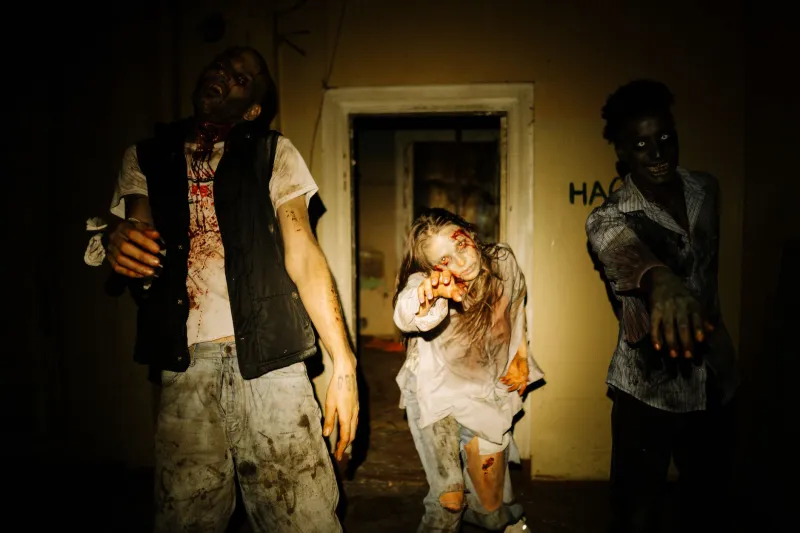
High-end Vegas haunted attractions treat their experiences as living systems. Performer rotations mean the same scene plays out differently depending on who's working that night. Subtle environmental changes — lighting adjustments, sound cue timing, the addition of small physical details in set dressing — accumulate over a season in ways that reward close attention. Some venues deliberately seed their attractions with hidden details, Easter eggs, and secondary narrative threads that can't be absorbed in a single walk-through.
"There's a whole layer of the experience that most guests never access," says one creative director at a major Vegas horror venue, speaking generally about the industry. "They come through scared and exhilarated and they leave. The people who come back three, four, five times start to see the architecture underneath the fear. They notice things. And honestly, we love those guests because they push us to keep adding things worth noticing."
Building for the Return Visit
The design philosophy behind repeat-visit optimization is more deliberate than most guests realize.
Attraction designers talk about layering — building experiences with multiple registers of engagement that operate simultaneously. The surface layer is pure scare mechanics: darkness, sudden movement, loud noise, the visceral stuff that works on everyone the first time. Underneath that are narrative layers — coherent story threads, character arcs, environmental storytelling that rewards guests who slow down enough to look. Deeper still are the Easter eggs: inside references, hidden symbols, micro-details planted specifically for the obsessive few who will come back looking for them.
"We think about it like a great movie," one longtime Vegas attraction designer explains. "The first time you watch it, you're just experiencing the story. The fifth time, you're noticing the foreshadowing in the background of scenes you didn't even register before. We want our spaces to work the same way."
Seasonal variations add another dimension. Many Vegas horror venues refresh significant portions of their attractions between seasons — new rooms, new narrative elements, updated scares — while retaining the core identity that fans return for. This creates a temporal layering where a four-year repeat visitor is experiencing something genuinely different from a first-timer, even inside the same walls.
The Annual Budget Line
For hardcore repeat visitors, Vegas horror isn't an impulse purchase. It's a planned expense.
Talk to the dedicated annual pilgrims and you'll find people who've built Vegas horror trips into their household budgets the way others budget for ski weekends or concert series. Flight and hotel, premium tickets, the occasional VIP upgrade — a serious multi-visit Vegas horror trip can run anywhere from $500 to well over $2,000 depending on how many attractions you're hitting and how many times you're going back.
Does that feel like a lot? Not to the people doing it.
"I could spend the same money on a week at a beach resort and have a fine time," says repeat visitor Marcus, who's been making annual Vegas horror pilgrimages for five years. "Or I can spend it on this, and I'll be talking about specific moments from specific visits for years. The return on memory is just higher."
That framing — horror experiences as memory investments — comes up repeatedly in conversations with dedicated repeat visitors. They're not just buying a scare. They're collecting reference points, building a personal archive of experiences that compound in meaning over time.
The Community That Forms in the Dark
Repeat visitors don't exist in isolation. The obsessive return-visitor community has developed its own social infrastructure — online forums, local meetup groups, informal networks of people who compare notes, share discoveries, and coordinate visits.
This community functions, in a real sense, as a quality-control mechanism for the attractions themselves. When dedicated fans notice something new, they post about it. When something that worked in a previous season gets changed or removed, they notice that too. The feedback loop between hyperattentive repeat visitors and the creative teams building these experiences is more active than most operators will openly discuss, but it's there.
"You know which guests are on their fourth or fifth visit," says one performer who's worked the same Vegas attraction for multiple seasons. "They move differently through the space. They're not scared the same way anymore — or they're scared differently, because they know what's coming and they're waiting for the variation. Those guests are almost more fun to work with, honestly. They're playing the same game we are."
What Keeps It Fresh
The central paradox of the repeat-visit phenomenon is that it works. Fans who should, by any rational calculation, be immune to surprises keep finding them. The fear response adapts, but something else kicks in — a connoisseur's appreciation for craft, a scavenger's pleasure in discovery, a social animal's satisfaction in sharing the experience with someone new.
For Vegas haunted attractions, the repeat visitor isn't an anomaly. They're the core audience. And building for them, season after season, is part of what keeps Vegas horror at the front of the pack.
Jamie is already planning her first visit of the new season. Row twelve of the spreadsheet is waiting.