Miles of Dread: How the Desert Drive Home Turns Your Vegas Horror Experience Into Something Far Scarier
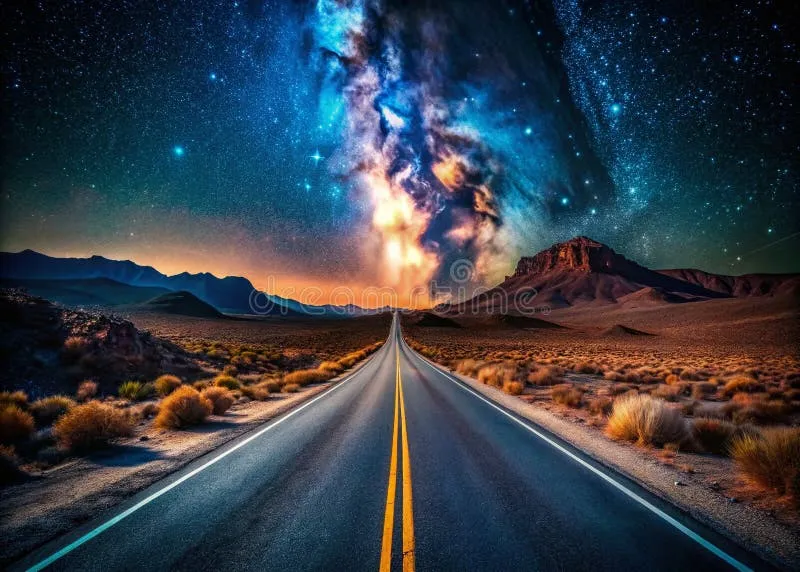
Photo: dark desert highway night driving Nevada lonely road, via thumbs.dreamstime.com
You survived. The strobe lights are behind you, the actors have moved on to their next victim, and the parking garage elevator is carrying you back to the ordinary world. You're laughing, maybe a little shaky, definitely telling whoever's next to you that it wasn't that scary. You feel good. Victorious, even.
Then you hit the freeway.
Somewhere past the last casino billboard, somewhere around the point where the city glow stops competing with the actual night sky, something shifts. The jokes dry up. The radio starts feeling too loud, then too quiet. Your passenger falls asleep, and suddenly you're alone with 200 miles of black desert and a brain that's been quietly stockpiling everything it didn't have time to process back inside the attraction.
Welcome to the part of Vegas horror that nobody puts on the ticket.
The Haunted House Doesn't End at the Exit
Anyone who's driven out of Las Vegas late at night knows the specific texture of that darkness. The Mojave doesn't do subtle. Once the Strip fades in your mirror, the emptiness is total—flat, vast, and indifferent in a way that feels almost aggressive. For most visitors, it's just a drive. For someone whose nervous system spent the last two hours being systematically terrorized, it's a completely different experience.
"I've done haunted attractions all over the country," says Marcus, a 34-year-old from Phoenix who drives to Vegas every October specifically for the Halloween season. "But the drive home from Vegas ones hits different every single time. I'll be fine in the parking lot, fine getting gas, and then somewhere on the 93 I'll just start replaying stuff. Details I didn't even consciously notice at the time."
That delayed replay isn't a glitch. It's your brain doing exactly what it was built to do.
What Your Brain Was Too Busy to Do Inside
When you're moving through a haunted attraction, your threat-detection systems are running hot. The amygdala—your brain's internal alarm system—is flagging stimuli faster than your conscious mind can evaluate them. Loud noise. Movement in peripheral vision. Unexpected touch. The smell of something chemical or metallic. Your body is responding to all of it in real time, flooding your bloodstream with adrenaline and cortisol, keeping you primed for whatever comes next.
What it doesn't do, in the middle of all that, is actually think.
Conscious memory consolidation takes a back seat when survival responses are running the show. The hippocampus, which handles the filing and organization of experiences into long-term memory, gets deprioritized. So you move through the attraction in a kind of heightened blur, reacting but not fully absorbing.
Then you leave. The immediate threat is gone. Your body starts the slow process of standing down. And the hippocampus gets back to work—sorting, cataloging, and replaying everything it didn't have bandwidth for before.
The timing of that processing? It often hits somewhere between 45 minutes and two hours after the experience ends. Which, if you're driving back to Phoenix or LA or Salt Lake City, puts it squarely in the middle of the most desolate stretch of highway you'll cross all year.
Why the Desert Makes It Worse (and Better)
There's a reason horror movies love isolation. Empty spaces trigger a primal unease that's hardwired into us—evolutionarily, being alone in open terrain without shelter or community was genuinely dangerous. The desert highway delivers that stimulus in full, uncut doses.
No streetlights. No other cars for long stretches. The occasional semi blowing past. Your headlights punching a narrow tunnel through the dark and illuminating absolutely nothing reassuring.
For a nervous system that's already running warm from a haunted attraction, this environment doesn't let the fear dissipate—it gives it room to breathe and expand. The silence that should feel peaceful instead feels like anticipation. The emptiness reads as threat. Your brain, primed by two hours of manufactured horror, starts pattern-matching against the real landscape and finding plenty to work with.
Jessica, a 28-year-old who made the drive back to Los Angeles after a particularly intense Vegas attraction last fall, described it this way: "I kept thinking I saw things on the side of the road. Like figures. I knew it was just bushes or rocks or whatever, but my brain kept going there. I had to wake my boyfriend up because I genuinely couldn't handle being the only one awake in the car."
Here's the flip side, though: that same isolation is also what makes the experience complete in a way that's hard to replicate. The fear gets space to resolve on its own terms, at its own pace. Visitors who've done this enough times—the October regulars, the hardcore haunt enthusiasts—often describe the drive home as an almost meditative extension of the experience. The dread becomes something to sit with rather than escape from.
Practical Ways to Manage the Miles
If you're planning a Vegas haunt trip and you've got a long drive ahead, a little preparation goes a long way.
Don't drive alone if you can help it. Having another awake person in the car isn't just about safety—it's about giving your nervous system something to anchor to. Conversation, even mundane conversation, helps regulate the threat-detection response and keeps the replay loop from taking over.
Build in a decompression stop. Grabbing coffee or food somewhere between the attraction and the freeway gives your body time to start the come-down before you're committed to a dark highway. Even 20 minutes in a well-lit diner does a lot to reset the baseline.
Be deliberate about your audio. Dead silence on a desert highway after a haunted attraction is a specific kind of torture. But jarring, high-energy music can feel wrong too—it creates its own kind of sensory friction. A familiar podcast, a comfort playlist, or even an audiobook you've heard before can occupy just enough of your attention to keep the replay loop from dominating.
Let the passenger seat person stay awake. This sounds obvious, but it's worth saying: if you're the driver, advocate for yourself. The person who gets to sleep it off in the passenger seat is leaving you alone with a primed nervous system and an empty highway. That's not fair, and it's not safe.
Know that the feeling will pass. The cortisol will metabolize. The memories will file themselves. By the time you're home and in your own bed, the fear will have completed its arc. What you're left with is a story, and usually a pretty good one.
The Strip in Your Rearview
There's something almost poetic about the way Vegas horror works. The city pulls you in with lights and noise and sensation, wrings every possible reaction out of you, and then sends you back out into the dark—where the real processing begins.
The haunted houses on the Strip are exceptional at what they do. But the desert? The desert is a collaborator they didn't even hire. It just shows up every night, doing its part, turning a two-hour attraction into something that follows you all the way home.
That's not a warning. It's kind of the whole point.
Next time you're planning a Vegas horror trip, don't just think about the attraction itself. Think about the drive. Pack accordingly. And maybe—just maybe—don't look too hard at what's standing in the headlights on the side of the road at 2 a.m.
It's probably just a Joshua tree.