Wired for Fear: The Science Behind Why Vegas Haunted Attractions Get Inside Your Head
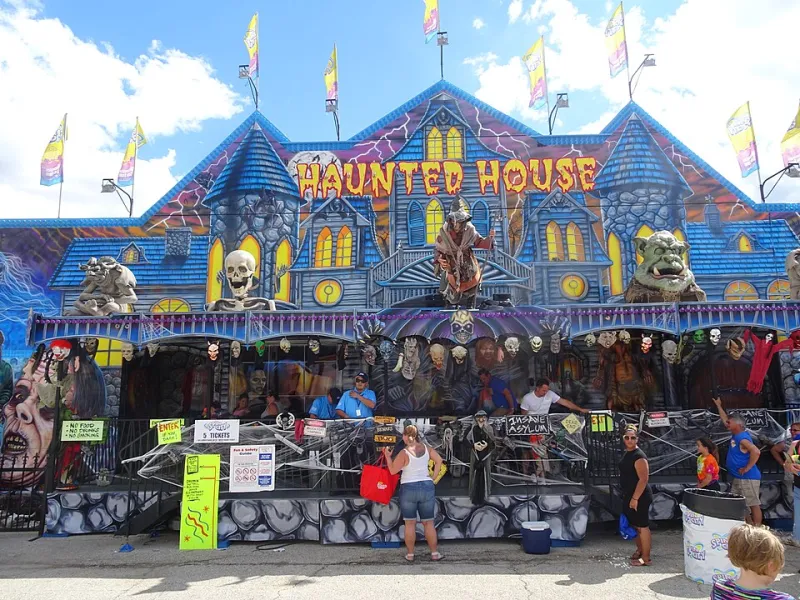
Photo: Corey Coyle, CC BY 3.0, via Wikimedia Commons
You're standing in a hallway that smells faintly of copper. The floor feels slightly uneven beneath your feet. Somewhere ahead, a sound — low, rhythmic, just barely audible — is doing something to your chest you can't quite explain. Then, nothing. Silence. And that's somehow worse.
Welcome to modern Vegas horror. Forget everything you think you know about haunted houses being glorified funhouses with strobe lights and teenagers in rubber masks. The premium scare experiences operating in and around Las Vegas have evolved into something far more calculated — and far more unsettling. These aren't attractions built around cheap thrills. They're built around you. Specifically, around the architecture of your nervous system.
We dug into the psychology and design principles driving the city's most talked-about haunted experiences. What we found is equal parts fascinating and deeply, deeply creepy.
Your Brain Doesn't Know the Difference
Here's the foundational truth that every serious haunted attraction designer understands: the human brain's threat-detection system is ancient, fast, and spectacularly easy to fool.
"The amygdala doesn't pause to fact-check," explains Dr. Renata Voss, a behavioral psychologist based in Nevada who has consulted for entertainment venues on anxiety and stress responses. "When it detects a pattern that matches a threat — a sudden movement, an unexpected sound, a face that looks almost human but not quite — it fires. It doesn't wait for your prefrontal cortex to weigh in and remind you that you paid forty dollars to be here."
That gap between instinct and rational thought is the real estate that Vegas haunt designers are working with. The goal isn't to make you logically believe you're in danger. It's to make your body feel like you are, even while your conscious mind knows better. That cognitive dissonance — knowing you're safe but feeling anything but — is the engine of genuine, memorable fear.
Sensory Manipulation: More Than Just Darkness
Amateur haunted houses turn off the lights. Professional ones rebuild your entire sensory reality from scratch.
Temperature is one of the most underrated tools in the arsenal. A sudden drop of even a few degrees can trigger a low-level threat response before a guest consciously registers the change. Smell is even more powerful — the olfactory system has a direct neural pathway to the limbic system, the brain's emotional core, which is why certain scents can produce visceral reactions that feel almost primal. Decay, iron, damp earth — these aren't random choices.
"We think about every sense as a lever," says Marcus Teel, a set and experience designer who has worked on multiple high-end Halloween events in the Las Vegas Valley. "Sound is the one people expect us to use, so we use it to mislead. We'll pump something unsettling into a room that's visually calm. Or we'll go completely silent right before something happens, because silence reads as wrongness to most people. The anticipation becomes the scare."
Audio designers on serious productions use binaural sound — recording and playback techniques that create the perception of three-dimensional sound without headphones — to make guests feel like something is moving behind them when nothing is there. Infrasound, frequencies below the threshold of conscious hearing, has been studied for its ability to produce feelings of unease, dread, and even the sensation of being watched.
The Uncanny Valley and Why Familiar Is Terrifying
One of the most reliable psychological levers in haunted attraction design is the concept of the uncanny valley — that deeply uncomfortable zone where something looks almost human, but not quite right. A figure that moves slightly too slowly. A face with proportions that are just a few millimeters off. A voice pitched in a register that doesn't match the body it's coming from.
Our brains are exquisitely tuned to read human faces and bodies. That sensitivity, which evolved to help us navigate complex social environments, becomes a liability in a haunted attraction. When something trips those detectors without fully resolving into "person" or "not person," the result is a low, sustained dread that's often more effective than a jump scare.
"Jump scares spike your heart rate for about three seconds," Dr. Voss notes. "Sustained wrongness keeps your cortisol elevated for minutes. If I had to choose between one loud bang and five minutes of something that feels off, I know which one sticks with guests longer."
Vegas attractions with serious production budgets invest heavily in this effect — through animatronics designed with deliberate imperfection, through actor training that emphasizes movement over vocalization, and through lighting that reveals just enough to unsettle without clarifying.
Disorientation as a Feature, Not a Bug
Lose your sense of direction and you lose a significant chunk of your sense of control. Haunted attraction designers know this intimately.
Sloped floors, curved corridors, and rooms where walls, ceilings, and floors are all covered in the same chaotic pattern — these aren't just aesthetic choices. They're spatial manipulation designed to knock guests off their psychological footing. When you can't reliably predict where you are or where the exit might be, the rational part of your brain gets louder, which paradoxically makes you more susceptible to fear triggers, not less.
"We want guests to be working harder mentally," Teel explains. "When you're trying to orient yourself, you have fewer cognitive resources available to rationalize away the things that are scaring you. The haunted house is essentially running a background process on your brain the whole time you're in it."
Some of the more extreme Vegas experiences incorporate elements of social isolation — separating guests from their group, or designing sections that must be experienced alone — to remove the psychological safety net that comes from being with people you trust.
The Consent Paradox
There's a fascinating wrinkle in all of this: you chose to be here. You bought the ticket. You drove to the venue. And yet your body is responding as though something genuinely threatening is happening.
Psychologists call this "voluntary fear" — the deliberate seeking out of experiences that trigger the threat response in a controlled context. Research suggests that the knowledge of safety doesn't neutralize the physiological response so much as it reframes it. The fear is real, but it's tagged differently in memory. Instead of trauma, it becomes thrill. Instead of something to avoid, it becomes something to seek out again.
That reframing is precisely why people line up year after year for the same experiences, why they bring friends, why they post about it obsessively online. The fear is genuine. The context makes it exhilarating.
Vegas, a city already built on the deliberate manufacture of heightened emotional states, turns out to be a near-perfect environment for this kind of experience. The infrastructure for spectacle is already here. The audience for it absolutely is too.
Next time you're sweating through a haunt on the outskirts of the Strip, heart hammering over something your rational brain knows isn't real — just remember. You're not being scared. You're being engineered.
And whoever designed that hallway knew exactly what they were doing.