Why Your Body Cracks Up When It Should Be Freaking Out
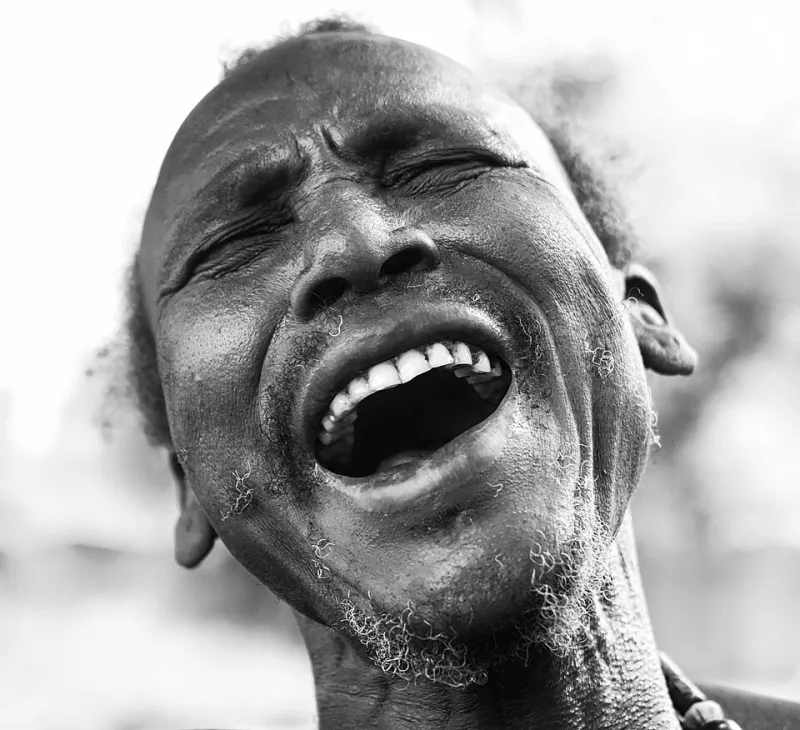
Photo: Rod Waddington, CC BY-SA 2.0, via Wikimedia Commons
It happens to almost everyone. You're shuffling through a pitch-black corridor, heart hammering, every muscle primed for flight — and then something explodes out of the shadows directly at your face. Your friends shriek. You? You lose it laughing like you just heard the best joke of your life. Nobody is more confused than you are.
Welcome to one of the strangest quirks of human neurology, and one of the most deliberately exploited tools in the Vegas haunted attraction playbook.
Your Brain Is Running Two Programs at Once
Here's what's actually going on under the hood. When you experience a sudden scare, your amygdala — the brain's threat-detection center — fires off an alarm signal before your conscious mind has even registered what it's looking at. Your body floods with adrenaline, cortisol spikes, muscles tense. The whole system kicks into high gear in milliseconds.
But here's where it gets weird. Almost simultaneously, your prefrontal cortex — the rational, thinking part of your brain — starts evaluating the situation. It looks around, notices you're in a haunted house you paid to enter, recognizes that the guy with the chainsaw almost certainly isn't going to actually dismember you, and essentially sends a memo that reads: relax, we're fine.
Those two signals — full-body alarm and cognitive reassurance — arrive at roughly the same moment and create a neurological traffic jam. Laughter, researchers believe, is one of the ways your nervous system discharges that collision of contradictory information. It's not that you find chainsaws funny. It's that your brain genuinely doesn't know what else to do with the mismatch.
"It's a release valve," says one veteran Vegas haunt designer who has been building large-scale horror experiences on and around the Strip for over a decade. "When we see a group come through and half of them are laughing hysterically, we don't see that as a failure. That's the system working exactly how we designed it."
The Science Has a Name for It
Psychologists call this phenomenon incongruity theory — the idea that humor (and laughter) arises from the gap between what we expect and what we get. In a haunted house, your body expects mortal danger. Your rational mind delivers the punchline: it's just a dude in a mask. Your nervous system laughs at its own overreaction.
There's also a strong social component. Laughter in group settings is contagious and serves as a bonding signal — a way of collectively saying we survived that, and we're okay. Horror attractions are almost always experienced in groups, which means nervous laughter spreads through a crowd the way a scream does, just with more cackling.
And then there's the adrenaline itself. The same chemical cocktail that makes your palms sweat and your pulse race also creates a kind of euphoric edge — which is precisely why people pay good money to be scared in the first place. When the threat resolves harmlessly, that adrenaline has to go somewhere. Sometimes it comes out as a scream. Sometimes it comes out as uncontrollable laughter. Sometimes, memorably, it's both at the same time.
Vegas Designers Are Mapping Your Nervous System
What makes Las Vegas haunted attractions particularly sophisticated is the degree to which the people building them understand — and deliberately engineer around — these involuntary responses.
Several designers interviewed for this piece described a deliberate technique sometimes called the reset: engineering a moment of apparent calm or even mild humor immediately before a major scare. The brief emotional exhale makes visitors lower their guard, and the contrast amplifies the terror of what follows. It also exploits the laughter reflex by priming the brain with a light, comedic signal — so when the real scare lands, the neurological wires are already slightly crossed.
"If we can get you to smile right before we get you, we've already won," one designer explained. "A smiling face is a relaxed face. A relaxed face is an open face. And an open face is going to give us the biggest reaction."
Other designers talked about pacing — the deliberate rhythm of tension and release that runs through a well-built haunted house like a musical score. Long stretches of creeping dread punctuated by sudden, violent scares keep the nervous system oscillating between high alert and cautious relief. Each cycle of tension-and-release makes the next one hit harder, partly because your body never fully resets, and partly because the accumulated adrenaline keeps building.
The Laugh That Gives You Away
There's another layer to this that haunt actors know intimately: nervous laughter is a tell. Experienced performers inside Vegas attractions watch for it the same way a poker player watches for a twitch. When someone in a group starts giggling a little too hard at something that isn't particularly funny, that's a signal the scares are landing — even if the person is trying to play it cool.
Some actors will deliberately hold back in those moments, letting the tension simmer rather than releasing it with a jump scare. Others will lean in, using sustained, low-key psychological pressure rather than a sudden shock — because they know that for someone already running hot on adrenaline and cortisol, a slow burn is often more effective than another explosion.
"The laughers are actually more fun to work with than the screamers," said one haunt performer with several Las Vegas-area seasons under their belt. "Screamers give you a big reaction and then they're done. Laughers are trying to hold it together the whole time. You can feel them fighting themselves. That's where the real game is."
You Can't Really Fight It
Here's the uncomfortable truth: knowing all of this doesn't help you much once you're inside. You can intellectually understand every mechanism at play — the amygdala hijack, the incongruity discharge, the adrenaline overflow — and still find yourself doubled over laughing in a haunted hallway while your friends look at you like you've lost your mind.
That's actually kind of the point. The best Vegas haunted attractions aren't just trying to scare you in the moment. They're trying to get under your skin in ways you can't fully predict or control. Exploiting involuntary biological responses — laughter, tears, full-body flinches, that weird sound you made that you're not going to talk about — is how they do it.
So next time you're standing outside a Vegas haunt, feeling confident and composed and maybe a little smug about how well you handle horror, just remember: somewhere inside that building, someone spent months designing an experience specifically calibrated to make your own nervous system betray you.
They know you're going to laugh. They're counting on it.